
Blog > Mortgage Rate Buydown Explained: How to Lower Your Payment (Real Example Inside)
Mortgage Rate Buydown Explained: How to Lower Your Payment (Real Example Inside)
by
“What if I told you your payment could be $500+ lower per month?”
That’s not an exaggeration.
In today’s market, one of the most powerful strategies I’m using to help buyers—and sellers—is something called a rate buydown.
If you’re buying a home (or even selling one), understanding this could literally change how affordable a home feels.
Let’s break it down in a simple, real-world way.
What Is a Mortgage Rate Buydown?
A rate buydown is a strategy where money is used upfront to reduce your interest rate—either temporarily or permanently.
This money often comes from:
- Seller concessions
- Builder incentives
- Or negotiated credits during the deal
Instead of just lowering the price of a home, you can use that same money to lower your monthly payment, which is often much more impactful.
The Two Types of Buydowns You Need to Know
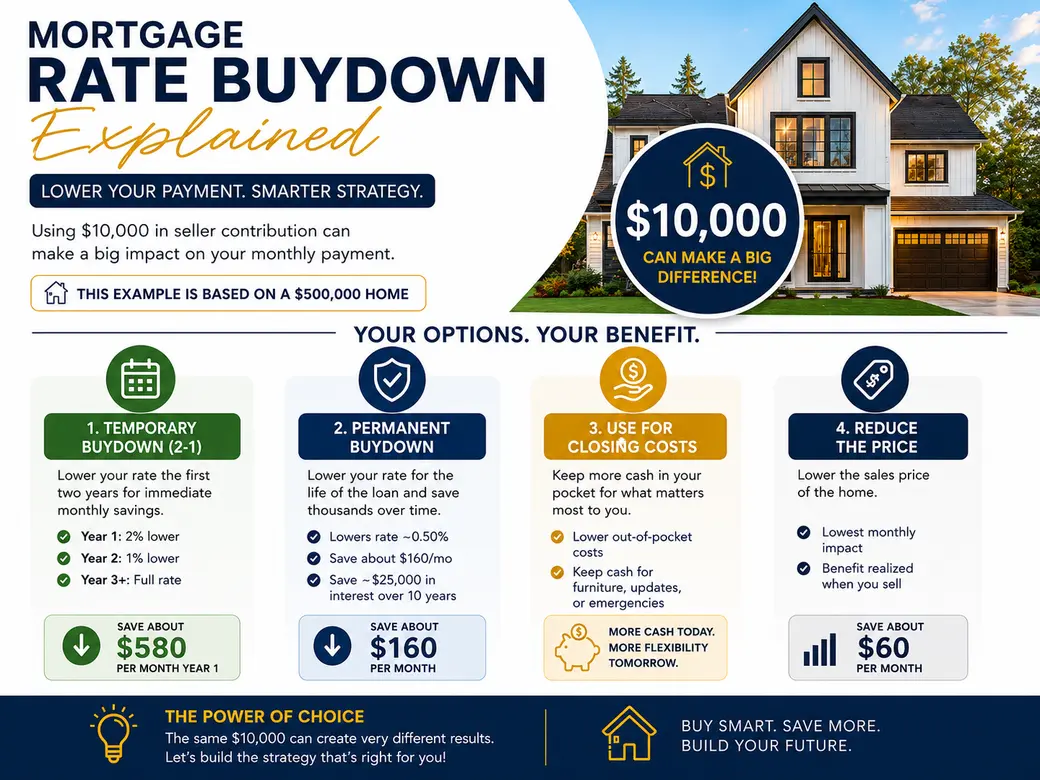
1. Temporary Buydown (Most Popular Right Now)
This is typically called a “2-1 Buydown.”
Here’s how it works:
- Year 1 → Rate is 2% lower
- Year 2 → Rate is 1% lower
- Year 3+ → Full market rate applies
👉 Example:
If rates today are 6%: on a $500K Home
- Year 1 → 4%
- Year 2 → 5%
- Year 3 → 6%
That’s a huge difference in your monthly payment early on.
In fact, in a real scenario:
👉 A buyer could save about $580 per month in the first year
That’s significant.
Important Detail Most People Don’t Know
With a temporary buydown:
- The money sits in a “reserve account” (like a piggy bank)
- It is used monthly to subsidize your payment
- If you refinance or sell early, the unused money is NOT lost
It either:
✔ Goes toward your loan balance
✔ Or helps you at closing
👉 This makes it a very flexible strategy
2. Permanent Buydown (Long-Term Strategy)
This option reduces your rate for the entire life of the loan.
It works through something called discount points:
- 1 point = 1% of your loan
- Each point lowers your rate (typically ~0.25%)
👉 Example from a real scenario:
- $10,000 seller credit
- Buys about 0.5% lower rate permanently
What does that mean?
- About $160/month savings
- Over time → ~$25,000 saved in interest in 10 years
Buydown vs Price Reduction (This Is Where It Gets Interesting)
Let’s compare using $10,000:
Option 1: Reduce Price
- Saves about $60/month
Option 2: Temporary Buydown
- Saves ~$500+/month first year
- Then gradually increases
Option 3: Permanent Buydown
- Saves ~$160/month long-term
👉 Same $10,000… completely different outcomes.
Which Option Is Best? (Depends on You)
This is where strategy comes in.
🔹 Temporary Buydown (Short-Term Advantage)
Best if:
- You expect to refinance in 1–3 years
- You want the lowest payment NOW
- You’re comfortable with future payments
🔹 Permanent Buydown (Stability)
Best if:
- You want predictable long-term savings
- You plan to stay in the home
- You prefer lower risk
🔹 Use It for Closing Costs (Cash Strategy)
Best if:
- You want to keep money in your pocket
- You need funds for:
- Furniture
- Renovations
- Emergency reserves
🔹 Reduce the Price (Least Impactful)
- Small monthly benefit
- Delayed return (only realized when you sell)
A Strategy Most Buyers Overlook
Instead of using the $10,000 in the home…
You could:
- Keep it (via closing cost credits)
- Invest it
👉 At a 6% return:
- $10,000 → ~$18,000 in 10 years
That’s a completely different financial outcome.
Why This Matters for Sellers Too
If you’re selling your home:
Instead of saying:
👉 “Price reduced $10,000”
You can market:
👉 “Payments as low as X/month”
👉 “Rate as low as 4% first year”
That creates:
✔ More attention
✔ More urgency
✔ More perceived value
This strategy can make your listing stand out significantly.
My Advice as a Broker + Loan Officer
Right now, the smartest deals I’m structuring include:
✔ Negotiating seller contributions
✔ Structuring buydowns strategically
✔ Aligning financing with the buyer’s goals
Because the truth is…
👉 It’s not just about the price
👉 It’s about the payment, flexibility, and long-term strategy
Final Thoughts
A rate buydown isn’t just a loan feature—it’s a negotiation tool, financial strategy, and opportunity.
Used correctly, it can:
- Save you hundreds per month
- Improve affordability
- Increase your buying power
Want to See What This Looks Like for You?
Every scenario is different.
I can help you:
✔ Compare all options side-by-side
✔ Calculate real monthly savings
✔ Structure the best strategy for your situation
👉 Start here:
https://www.mrgrealty.com/apply-for-home-loan